Bridging mysticism, myth and psychology.
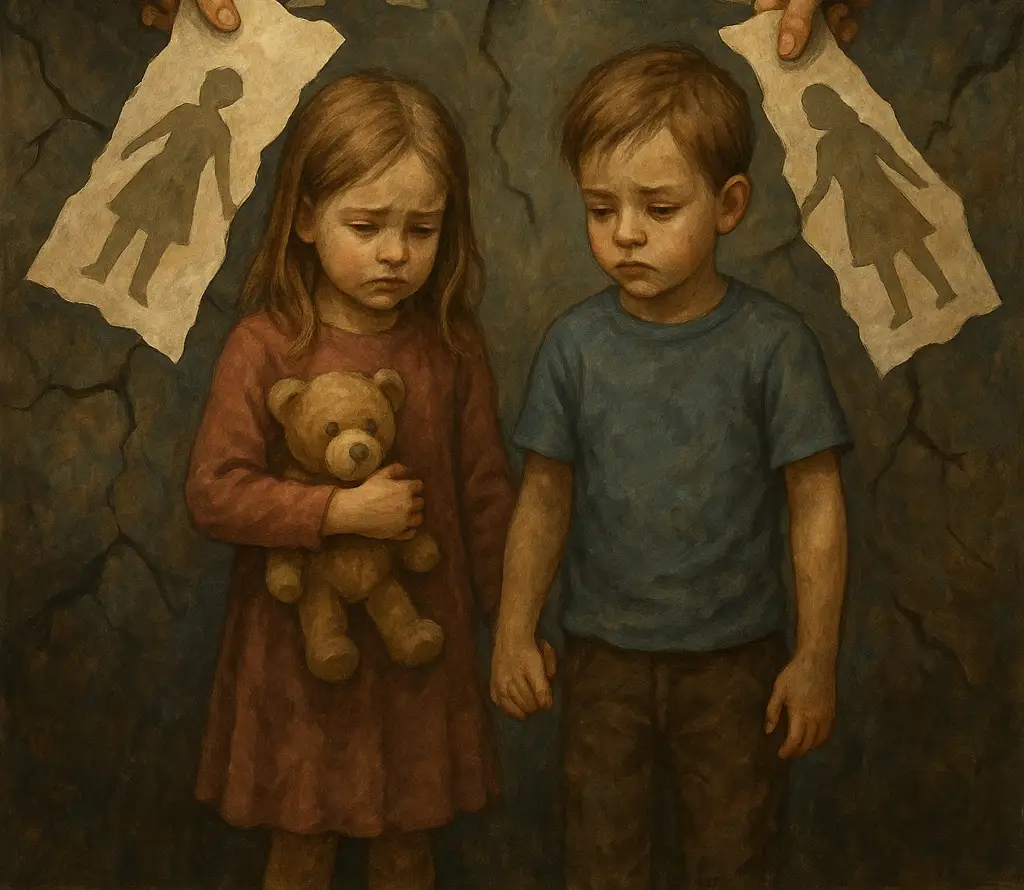
People come to me for depression. For anxiety. For the thing that happens somewhere around forty-three, when the life you spent twenty years building stops answering when you speak to it.
That is what they say on the call, and it is true but it’s not the whole Truth.
Because what they are actually asking for – without knowing they are asking for it – is to be relieved of something they have been carrying for so long that they have stopped experiencing it as weight. And here is the part that never makes it into the brochure: it will not simply be lifted off them. They will have to hand it over. Consciously. Knowing what it costs. Knowing they will grieve it afterwards.
So let me try to draw the map. Not the map of a retreat, not a protocol, not another framework with phases. Simply the way it looks from inside, using an image the Greeks worked out three thousand years ago.
Between Scilla and Charybdis
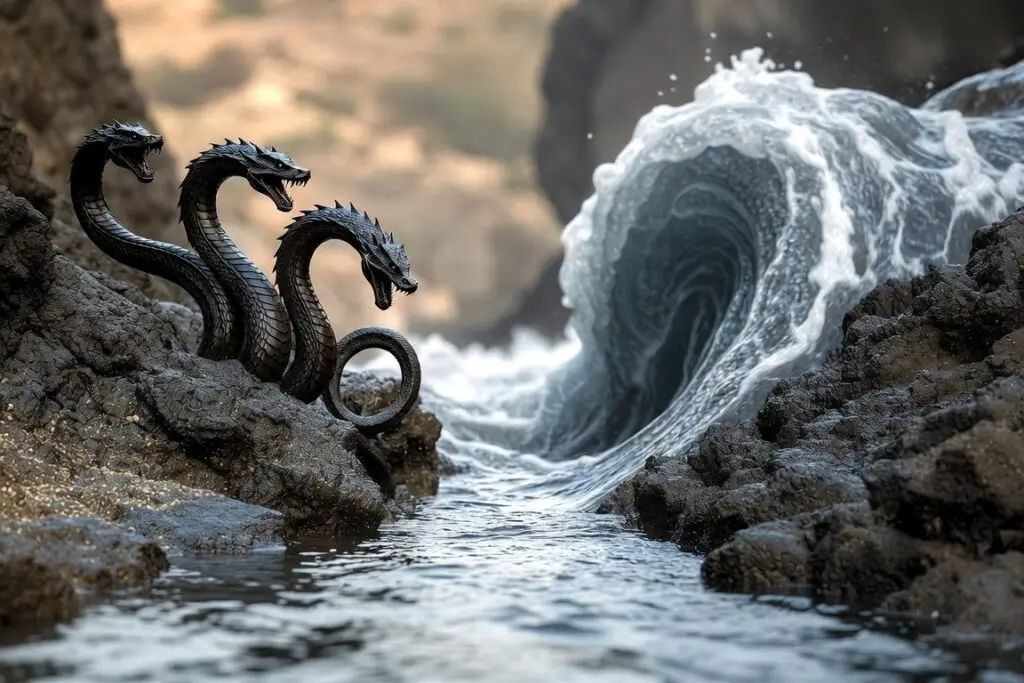
You know the story even if you have never read it. Two monsters. Scylla on one side, a thing of rock and teeth and heads. Charybdis on the other, a whirlpool that swallows the sea three times a day and spits it back.
The Greeks put these two across a narrow channel from each other, they did not put these at opposite ends of the world. Close enough that a ship passes both at the same time. Close enough that steering away from one is steering into the other.
That geometry is the entire psychology.
Scylla is the mind. The rock. Structure, intellect, rules, the part of you that names things and organises them and knows what should happen next. Solid. Defensible. Yang, if you like that language. It is the part of you that answers the phone.
Charybdis is everything underneath. The subconscious, the deep, the material you have never looked at directly. It is not evil and it is not chaos for the sake of chaos — it is simply enormous, and it moves according to laws you did not write. Yin. The part of you that produces the dream you cannot explain, the reaction that is four sizes too big for what just happened, the grief that arrives on a Tuesday for no reason at all.
And the point of the myth is that there is no course through life where you deal with one and leave the other alone. You cannot forever manage your thoughts and let the deep sit. You cannot dissolve into the deep and keep no structure at all. They are the same passage. They were always going to be the same passage.
Most of us spend the first half of life hugging the rock.
The thing that says no
Socrates said he had a sign. It had been with him since childhood, and he described its behaviour very precisely: it never told him what to do. It only ever stopped him. Mid-sentence, sometimes. It arrived before the reasoning arrived, it did not explain itself, and its entire vocabulary was no.
He called it his daimon. Centuries later the Church took the word and made it demon, and the inner voice was reclassified as the enemy. The operation of telling a person that the thing speaking inside them is not to be trusted is very old, and it is still running.
I think most people know exactly what he was talking about. The drop in your stomach when you say yes to something and don’t really mean it. The strange emptiness a week later after finally getting the thing you wanted. The ickiness in a room where everyone else is glowing.
It speaks in the body. It speaks almost entirely in refusal. And it arrives before you have finished thinking.
Now: what happens to a person who does not listen to it for twenty years?
It gets louder. It starts quietly, as a preference. Then as a mood. Then as a sleep problem. Then as the Sunday evening thing. And when all of that has been overridden long enough, it stops trying to persuade you and simply takes away your capacity to continue.
That is the depression. That is very often the anxiety.
I am not saying every hard state is meaningful; sometimes the body is depleted, sometimes the biology is genuinely broken and needs feeding before it needs interpreting, and I have written elsewhere about how badly the psychological world neglects this. But very often – more often than anyone wants to hear – the symptom is the call arriving in the only form left to it.
Which means the person on my call, asking me to help make it stop, has come to have the no silenced.
And what they have actually come for is to finally hear it – they just don’t know it yet.
Stage one: carried
Our hero, Jason sails the same strait. And he survives it — but look at how. Hera intervenes. She sends sea nymphs, and they physically pass his ship from hand to hand through the channel like women passing a bowl across a kitchen. He does not steer. He does not choose. He does not lose anything. He goes through the most dangerous water in the world and pays nothing at all.
Reads like a nice story, but I think it is a warning, and a cruel one, because of how Jason ends. Not in glory. He ends as an old man sitting in the shade of the ship that made him famous, the Argo rotting on the beach, and the hull comes down and kills him.
He was favoured. He was never tested. And a man who is never tested has nothing inside him to fall back on when the favour stops.
This is stage one, and there are two kinds of people in it and only one of them is obvious.
The first kind has never met Charybdis. They function. They are competent, often extremely competent, and they have arranged a life in which the deep is simply not consulted. They are not lying to anyone. They genuinely do not know it is down there.
The second kind has seen it — and thinks that seeing it was the crossing.
This is the one I want to talk to. You had the ceremony. Something opened. You saw, with a precision that no conversation had ever given you, exactly how the thing in you was built and where it came from and what it has cost. You wept, or you laughed, or you lay there and understood the universe. You went home glowing. You told people you were changed and you meant it and for a while it was even true.
And then it wore off, and you were the same person with a better story.
That is Hera. The afterglow is grace, and grace is real, and grace builds nothing. You were carried. The ship was never tested. And when the glow faded you did what Jason would have done: you looked around for someone to carry you again.
I say this without any superiority. It is the most common shape in this whole world, it is the natural response to having been shown something enormous and given no instructions.
The crossing nobody notices
Maybe being carried through is not the end of stage one. It is the beginning of stage two — and almost nobody recognises it as a beginning, because it feels so completely like an arrival.
The mystical experience is not a graduation. It is a summons.
Something opened, you saw the scale of it, and now you cannot unsee it. That is all that has happened. That is genuinely a great deal – it is the difference between a person who does not know the deep exists and a person who became aware of Charybdis. Because of our narrow psychological frame, we often stop here. But the entire work is what you do afterwards, on your own, with nobody’s hand under the hull.
I have said before that no amount of ayahuasca will change your life; you change your life.
The call has been answered. Now comes the price.
Stage two: the things you leave behind
Odysseus gets no nymphs.
Circe tells him in advance what the strait will cost. She is completely explicit: you cannot pass both. Charybdis will take everything — ship, crew, you. Scylla will take six. Steer for the rock. Take the six. Row hard and do not stop.
And then she tells him one more thing, which is the line I think about most: do not arm yourself. Just as I say in my retreats: Do not fight the process.
He arms himself anyway. Of course he does. He puts on his armour, takes two spears, stands on the deck watching the cliff, waiting for the monster so he can fight her. And while he is standing there braced for a fight that was never available to him, she comes down and takes six men out of the ship and he does not even see her do it.
The armour changed nothing. The loss was the same. He simply paid it and kept the illusion that he might not have had to. Ego death will still happen.
I cannot count the number of people I have watched do exactly this. Arriving armoured. Researching, preparing, optimising, reading everything, arranging to go through the strait without the loss. It is the most understandable thing in the world, but it does not work and it costs the same.
The six men are – the sacrifice
They are not traitors. They are not the weak ones or the ones who mutinied or the crew he was glad to be rid of. They are six loyal men who had rowed with him since Troy, who did nothing wrong, who were at their oars doing their job when the heads came down.
And that is exactly what psychedelics ask of you. You give up the armour that once protected you, for an open heart. You give up rigidity, for flow. Often you give up friendships and toxic relationships, that once were useful. Sometimes you give up careers that have no meaning.
What has to go over the side is not your bad parts. Your bad parts are easy; everyone is happy to give those up, that is why the resolution lists are so long and so useless. What has to go is your loyal parts. The behavioural adaptations from 2 or 3 decades ago.
The hypervigilance that kept you alive in a house where you had to read the mood across a room to know whether the evening was survivable. The competence that made you so necessary that nobody could leave you. The performing. The earning. The managing of everybody’s feelings before they have them. The charm. The self-sufficiency you are so proud of.
These served you. They are the reason you survived long enough to be sitting in a ceremony at all. They rowed you here.
And they have to go over the side, still loyal, still rowing.
We need to prepare people for the fact that healing involves grief – real grief, with a shape and a duration – for the defences that saved your life. You will miss them. You will reach for them. There will be an evening about four months later when you would give almost anything to have the numbness back, because the numbness worked, and the thing that replaced it is raw and slow and does not protect you at all. But that’s the crucible where you find yourself – if you’re courageous enough.
This is what I mean when I say the sacrifice is not optional.
And it is not optional in a very literal, geometric sense, which the Greeks understood perfectly: if you refuse to choose, you do not get to keep the six. Refusing is itself a course. The channel is narrow. Not choosing is a drift toward the whirlpool, and Charybdis does not take six, she takes the ship. That is what the collapse at fifty looks like. That is what the illness that arrives out of nowhere often is. The people who would not pay six paid everything, and they paid it later, and they paid it without the dignity of having chosen.
There is no third channel. I have looked. There is no gentle route where you keep the defence and lose the suffering it produces, because they are the same object seen from two sides.
The people who willingly do the sacrifice are the once that succeed on their hero’s journey. Everyone else still fixes symptoms.
But which six?
If the sacrifice is not optional, and if what must go is not your worst parts but your most loyal ones — then how on earth do you know which?
You cannot reason your way there. The mind is Scylla; it is a rock; it will defend the defence with extraordinary sophistication and it will do it in the language of insight. I have listened to people describe with total precision exactly which pattern is destroying their life, and then explain, beautifully, why in their particular circumstances it must be kept.
The daimon knows. That is what it is for. It is the selection principle. The thing that has been saying no since you were small is saying no to something specific, and it always was.
And this is precisely where a person in stage two is most vulnerable – because they can feel, correctly, that something must go over the side, and they cannot yet hear which. That is an unbearable position. I call this stage “The void”.
What it looks like when someone else chooses
I spent some time inside an organisation called Inner Mastery. Most of what I know about it I know because I was there; the rest was documented in an investigation by Sam Edwards for the Guardian, which is worth your time if you want the full account. I do not want to write the full account. The man who founded it is dead and I am not interested in a crusade. I am interested in one mechanism, because the mechanism is the point of this essay.
Every couple of months, a group flew to Colombia to journey with Ayahuasca in an “Authentic setting”. Facilitators in training, mostly, and a few guests. They paid for the trip. That is the first payment.
Then they worked. They gathered the vine, cleaned it, cut it, cooked it down over days, drank part of what they had made. That was the second payment, made in labour, and nobody experienced it as a cost, because it does feel special to be close to the plants. It felt like the opposite. It felt like finally being let in.
Then they packed it into their suitcases and flew home.
Which is the third payment, and it was quoted in a currency nobody mentioned at the time. On a first field test, ayahuasca reads positive for methamphetamine. It takes a proper laboratory analysis to establish otherwise, and that analysis takes months, and you spend those months somewhere you had not planned to be. So the third payment was potentially months of your life, carried through customs folded between your shirts, on behalf of a man whose affairs were arranged so that nothing was ever in his name.
And then the medicine they had paid for, worked for and carried was sold back to them at the gatherings in Madrid.
You could call those people fools. They were not fools, and if you decide they were, you will learn nothing from them — because look at the structure. Pilgrimage. Labour. Risk. Those are the three features of every genuine initiation that has ever existed anywhere. The people in that airport were not confused about what initiation looks like. They were right. The sacrifice was real, and it hurt, and it meant something.
But the decision what the sacrifice is was coming from an outside authority and that never works.
So how does this work then? How do we pass the narrowing between Scilla and Charybdis? We established we have to give something up. Not to an outside authority. But to ourselves. Here’s some guidance:
Does it end? A genuine initiation terminates. You go in, you pay, you come out initiated, and then it is over and you go and live. Many people in that organisation spent three years and around ten thousand euros on a training cycle that kept not completing – and understood later that the delay was because they had money. Something that never finishes is not an initiation. It is a subscription.
Which way does the risk run? In any container worth the name, the person with the authority carries the risk. Here it was inverted, elegantly, through companies inside companies so that no one could see the whole shape at once. The man at the top could never be caught holding it. The people at the bottom held it in their luggage.
And what did the losses connect you to? This is the one that decides it. Look at everything that organisation asked people to throw overboard: end the relationship. Leave the job. Move into the house. Take payment in the company’s own tokens. One woman was told that caring for her elderly father was a prison.
Every single one of those is a counterfeit six men. The grief was real. The person genuinely gave something up and genuinely felt the weight of it. And what went over the side was always, without exception, the thing that tied them to a life outside the group.
That is the tell. Real sacrifice throws off the defence and leaves the ties intact. The counterfeit throws off the ties and leaves the defence completely untouched — because the defence is what keeps you rowing.
And underneath all of it, one mechanical fact: that system could only ever say yes. Go deeper. Take more. Commit harder. Your doubt is resistance, your exhaustion is resistance, your fear is your ego defending itself. A woman stopped breathing after a dose of yopo and was congratulated on having had the best process in the room.
There was no NO anywhere in the machine. Which is precisely what makes it the opposite of a daimon, and precisely why it had to teach people to distrust their own. Nausea became purging. Terror became process. Disgust became resistance. Every alarm the body raised was renamed as evidence that the work was happening — and I have written before about the body being the part people most want to skip, but this is worse than skipping it. This is recalibrating the instrument to read danger as progress.
The founder wrote something once, back in his marketing years, long before any of this: that people pay to be told lies. He found it remarkable how easily a man can be led.
That was the thing he never threw overboard.
The same failure, alone, at four in the morning
Now the part that actually concerns you, because you are almost certainly not in a cult.
Everything I have just described happens inside single people, constantly, with no organisation required.
A part of you takes the throne. It is usually the part that got you through — the disciplined one, the spiritual one, the one who reads. It starts making all the decisions. It cannot be questioned. And anything that contradicts it gets reframed, in exactly the same vocabulary, as resistance.
You tell yourself your exhaustion is a lack of commitment. You tell yourself the thing you want is proof you have not done the work. You override the pull in your stomach and call it non-attachment. You choose the sacrifice that impresses you rather than the one that is actually due, and you feel the grief, and the grief convinces you it was the right one — because it hurt, and you have learned that healing hurts.
That is a one-person Inner Mastery. It has a guru, a doctrine, a mechanism for converting every internal objection into evidence of insufficiency, and a follower who never leaves. The commune is only the externalised version, with a payment plan.
This is why the map matters. Not so that you can identify a bad organisation — you can usually do that eventually, at cost. So that you can notice when you are running one on yourself.
You need to do the work. To say not to that job that demands too much of you. To leave that toxic relationship. To ask for some distance from your demanding parents. To stop lying to yourself that everything is fine. To do that grounding practice. You name it. You need to sacrifice something.
Stage three
Once you’re on that path, stage three is when you recognize that there is no battle. You don’t choose between Scilla and Charybdis, you dance with them.
The Taoists have the better language here. Odysseus survives by over-steering — hard toward the rock, hard toward structure and control, because the whirlpool means annihilation. That is correct for stage two. That is what stage two is. But it is still a fight, and a life spent hugging the rock to avoid the deep is a narrower life than it looks from inside.
Wu wei is not passivity and it is not surrender. It is what becomes available when you stop treating the current as an enemy. The structures of your daily life and the movements of your deep are not two hostile territories that you must broker between. They are one system, and a person who has genuinely integrated them uses structure as a tool and the deep as a well, and stops needing to defend one against the other.
In practical terms, here is how I would recognise it. In stage three, the no arrives early and quietly, and gets acted on the same afternoon. Nothing has to escalate. Nothing has to become a symptom to get your attention, because you are already listening. The daimon does not need to shout, because it has never once been ignored.
And this is the part I would put in bold if I put anything in bold: in stage three, people are free of me, and free of the medicine and it brings me so much joy when I find them there.
That is what the work is for. Not a practice you maintain, not a teacher you return to, not a ceremony twice a year forever. A person who can hear their own signal does not need me to reflect it back to them, and does not need a substance to turn the volume up. The whole apparatus – me included – exists to be outgrown.
Which is also the simplest test you can run on anyone offering you anything in this field, including me. Ask what their work is aiming at. If the honest answer is that you will still need them in five years, you have your answer.
Integration is not a straight line, it’s a spiral.
You occasionally end up where you started.
I am not always in stage three.
I still journey two or three times a year. I am not free of the medicine, and I am not going to pretend otherwise in an essay whose entire argument is that pretending is the failure mode. Sometimes I need the volume turned up. Sometimes the no has been speaking for a while and I have been too busy to hear it, and I need a night in the dark to be told something I already knew in April. It’s hard to let go. I love my mind, and I tend to spend too much time embracing Scilla, rationalizing everything. And I still pay the price.
But I know the map now. I know what I am doing when I do it, and I know what it means that I still need it, and I can steer toward the far side instead of drifting back toward the rock. Many days that is the whole of the practice: noticing which way you are drifting and correcting, in small amounts, more often.
That is not modesty and it is not a disclaimer. It is the only honest position available to anyone who is still in the strait, which, as far as I can tell, is everyone.
Circe told Odysseus the price in advance. He did not pass it on to his crew — he judged that six men, told they were already chosen, would stop rowing. He was probably right. He also spent the rest of his life carrying it.
I tell people. It is why I turn so many of them away. You need to be ready to pay the price of freedom.